

Q & A
My campaign is built on one principle—engagement.
The Questions & Answers page is more than just information; it is a direct line of communication between leadership and membership. It reflects a commitment to transparency, accountability, and the belief that every voice within our organization matters.
This is your opportunity to be part of the process—not just to observe it.
Ask the questions that matter to you. Challenge ideas. Bring forward concerns. Share your perspective from the Post level to the Department level. The strength of this campaign is not in one voice—it is in all of ours, working together with purpose and direction.
We do not move forward through silence. We move forward through conversation, understanding, and action.
If you want a stronger, more unified Department—step in, ask your questions, and be part of building it.
QUESTION 1
I am writing to find out what your qualifications are to become Department Commander. I have only heard your name over the past year. Since I spent part time in Florida I may have missed exactly where you come from and what duties you have performed in the organization.
You see, it's very important that the person we elect to this state's highest position requires that person to be fully qualified to lead us into the future. Things like holding many different offices and knowledge of the By-Laws are most important. However, the most important quality is your Leadership..
Could you provide some insight on what you feel the direction of the Department is?
Can you list your qualifications?
If you have a flier please provide.
I have copied all current District Commanders and Past State Commanders as they may have questions as well.
One of my biggest concerns is the decline in membership. I was State Commander 2016/2017 and our 100% membership was above 79,000. Look at where we are today- just over 50,000.
In just 8 years we have lost almost 30,000. At that trend we will be out of business in about 10 years. What are your thoughts on how to correct this decline?
PSC Dale Smith
ANSWER 1
I believe the future direction of the VFW must be grounded in relevance, accessibility, and service excellence for the next generation of veterans and their families. Our number one strategic priority is sustainable membership growth, driven by purpose-built programs that resonate with post-9/11 veterans and family units. This requires a cultural shift from a legacy-only model to an inclusive, service-forward ecosystem that reflects the lived realities, professional needs, and mental health challenges of today’s veteran population.
To support this growth, the Department must elevate post-level leadership capacity by providing structured, standardized educational resources for Post Commanders and officers—specifically in business operations, nonprofit governance, compliance, fundraising, and facility sustainability. Well-trained commanders create resilient Posts, and resilient Posts retain and attract members.
Equally essential is universal access to mental health resources for all members and families, integrating evidence-based services, peer-support networks, crisis response pathways, and emerging therapeutic modalities. Mental wellness must be treated not as an auxiliary function, but as a core mission deliverable.
The Department must also formalize strategic partnerships with other veteran service organizations, county agencies, and nonprofits to bridge the Certified Veterans Service Officer (VSO) gap—ensuring every veteran, regardless of geography, has timely access to benefits navigation, claims assistance, and advocacy.
Finally, the Department of California must be modernized into a 21st-century organization through disciplined technology adoption: digital training platforms, secure document retention systems, collaborative knowledge repositories, and data-driven performance dashboards. These tools will enhance continuity of operations, reduce institutional knowledge loss, and professionalize service delivery statewide.
In sum, this strategic direction positions the VFW Department of California as a future-ready, veteran-centered institution—one that honors legacy while decisively investing in relevance, growth, and impact for generations to come.
Paragon
QUESTION 2
Will you be able to attend every district meeting to campaign for Jr. Vice Commander?
ANSWER 2
No—unfortunately, I will not be able to attend every district in person during the campaign. I have already attended several districts and will continue to visit as many as possible leading up to the election in June.
At the same time, I’ve embraced a modern approach to campaigning by utilizing Teams meetings, encouraging candidate visibility on the Department website, and developing my own website to ensure members have access to comprehensive information about who I am and what I stand for.
If elected, my commitment remains firm: to support every Post and every District by ensuring they have the resources, communication, and leadership needed to be successful—regardless of geography.
Paragon
QUESTION 3
What is your opinion of the negative campaigning against some of the candidates?
ANSWER 3
While I understand that campaigning can be a mental and verbal exchange of ideas, I believe some of the rhetoric directed at candidates has crossed into disinformation—claims that are unsupported and, at times, driven more by anger and fear than by facts.
That kind of approach doesn’t strengthen the organization; it undermines it. It creates division within the Department at a time when our focus should be on what unites us—serving veterans in need and strengthening our Posts and communities.
We have to be disciplined as leaders and members not to get pulled into emotionally driven distractions. A divided organization cannot effectively carry out its mission. Our strength has always come from unity of purpose, and that is where our attention needs to remain.
Paragon
QUESTION 4
Why do you think the membership numbers are dropping.
ANSWER 4
The numbers tell a story—but not the whole story. Part of what we’re seeing in the Veterans of Foreign Wars is not just decline, it’s truth. In 2019, National made the hard decision to remove deceased members so we could stand on real numbers. Therefore, approximately 12,260 deceased members were deleted from our membership rosters. They continue to remove the deceased members every year since. That took courage—and now it’s our turn.
This is our moment to rebuild—not just membership, but purpose. To create Posts where veterans feel welcomed, valued, and needed. To lead with unity, not division. Veterans aren’t looking for a place to sign up—they’re looking for a place to belong. If we build that together, membership won’t just recover—it will grow.
Post-9/11 veterans aren’t disengaged—they’re underserved. They’re looking for purpose, connection, and impact. If we meet them where they are, modernize how we operate, and create a culture where they feel valued and needed, they will come. The future of the VFW isn’t about asking younger veterans to adapt to us—it’s about us evolving to serve them.
You don't convince younger veterans to join. You build something they don't want to walk away from.
Membership by the numbers
| Year | California Membership Total | Death Rate Decrease (average ~4%) | Comments | Commander | Actual Membership increase/decrease |
|---|---|---|---|---|---|
| 2018 - 2019 | 76,605 | National started to decrease membership based on deceased members. | LaMont Duncan | ||
| 2019-2020 | 64,345 | 2,573 | Mike Kuznik | +2,245 | |
| 2020-2021 | 64,717 | 2,588 | John Lowe | +291 | |
| 2021-2022 | 62,420 | 2,496 | Post covid numbers | Dusty Napier | -2,898 |
| 2022-2023 | 57,026 | 2,281 | Marty Yingling | +1,276 | |
| 2023-2024 | 56,021 | 2,240 | Tim Bryant | +2,242 | |
| 2024-2025 | 56,023 | 2,241 | Deb Johnson | +2,241 | |
| 2025-2026 | 53,296 | 2,131 | David Kuta | No data yet |
This is an approximate calculation. The average veteran mortality rate is ~3% - 5% per year.
Membership decline is not just a recruiting issue—it’s a demographic inevitability. We are losing 3–5% of our members every year to age. If we are not replacing them at that rate, we would be shrinking. Based on the numbers above the actual membership is doing well. Keep up the good work.
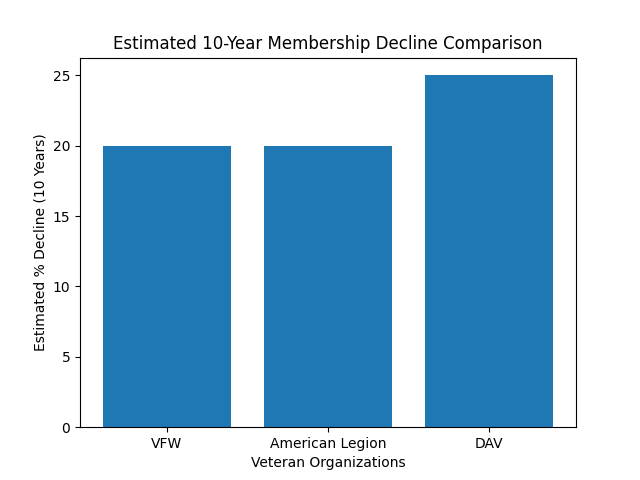
Below is a National side-by-side estimate of membership declines over several organizations for the past 10 years. 2016-2026
Organization Approx. 10-Year Decline Key Driver
VFW🔻 15–25% Aging membership, membership correction, overseas-only eligibility
American Legion🔻 15–25% Aging + weaker recruitment of post-9/11 vets
DAV🔻 20–30% Aging + shift toward newer service orgs
We fix the decline by making the VFW useful, welcoming, modern, and united. Mission first. Service first. Leadership first. If we build an organization veterans are proud to belong to, membership will follow.
HERE IS A MUCH LONGER ANSWER
1. Make the VFW useful again
Veterans stay where they get value. Every post should be able to answer:
- How do we help veterans with claims, benefits, jobs, housing, and crisis support?
- How do we help families?
- How do we help student veterans and younger veterans connect?
If a post is known only as a bar or meeting hall, membership will continue to fall.
If it becomes a place of service, advocacy, mentorship, and community, growth becomes possible.
2. Stop the internal division
Nothing drives people away faster than negativity, infighting, and public attacks.
Veterans want leadership, not drama.
A divided house does fall.
That means:
- less finger-pointing
- less gossip
- more accountability
- more unity around mission
People will tolerate limited resources. They will not tolerate toxic culture for long.
3. Build a younger-veteran pipeline
The VFW cannot wait for younger veterans to find it on their own.
Go where they already are:
- colleges and universities
- student veterans associations
- military transition events
- local veteran resource centers
- community service events
- digital platforms
Younger veterans often join causes before they join institutions.
So lead with mission first, membership second.
4. Modernize how you communicate
Many organizations still communicate as if it were 1995.
Use:
- websites that are current
- Teams or Zoom town halls
- social media with a clear message
- text and email updates
- online calendars and event registration
- short videos from leadership
The message should be simple:
Here is who we are. Here is what we do. Here is how you belong.
5. Give members a reason to participate immediately
A new member should not have to wait six months to matter.
When someone joins, give them:
- a welcome call
- a simple orientation
- one meaningful role
- one service project
- one leader who checks in
Retention starts in the first 30 days.
6. Focus on mission, not only meetings
Veterans are more likely to show up for:
- helping another veteran
- mentoring students
- disaster relief
- food drives
- suicide prevention efforts
- community advocacy
- family support programs
Service creates identity. Identity creates loyalty. Loyalty creates membership.
7. Train post leadership better
A weak post usually has one of three problems:
- poor leadership
- poor financial discipline
- poor communication
Strong departments invest in commander, quartermaster, and adjutant training. Not once a year. Repeatedly.
Training should include:
- membership development
- conflict management
- financial compliance
- meeting management
- community outreach
- digital tools
- volunteer engagement
8. Measure the right things
Do not only track total membership.
Track:
- new members by age group or era of service
- retention rate
- event attendance
- volunteer hours
- referrals to benefits help
- number of community partnerships
- number of student veterans engaged
- number of inactive members reactivated